
The New Luxury: Why the Future Belongs to the Artisan, the Analogue, and the Absent
While Gucci's brand value fell 35% in 2025 and Louis Vuitton's declined by nearly 5%, Hermès grew by over 17%. One brand, more than any other, has held its nerve: no logo inflation, no trend-chasing, no compromise on craft. The divergence is not an anomaly. It is a signal.
The luxury market is in the middle of its most significant structural reset in a generation. Between 2022 and 2024, fifty million luxury consumers exited the market, according to Bain & Company. The Hermès Birkin, once the clearest shorthand for extreme wealth, found a near-identical imitation on Walmart's shelves for $80. And across the industry, McKinsey found that rapid expansion had "weakened the industry's promise of exclusivity, creativity, and craftsmanship."
Deloitte's Global Powers of Luxury 2026 report, drawing on interviews with 420 senior executives across ten countries, describes the current moment plainly: luxury is entering a phase defined by "stabilization, selectivity, and significance." Value over volume. Meaning over scale.
But what does meaning look like in 2026? What is actually replacing the old playbook?
Four converging forces are reshaping what luxury means for the coming decade, not as trends in the conventional marketing sense, but as structural shifts in how affluent consumers signal identity, build their lives, and decide where to spend. For brands operating in the premium and luxury space, understanding them is not optional. It is the difference between the 17% trajectory and the 35% one.
“Slowness is the signal.”
I. The Artisan Economy: Human Hands as the Rarest Raw Material
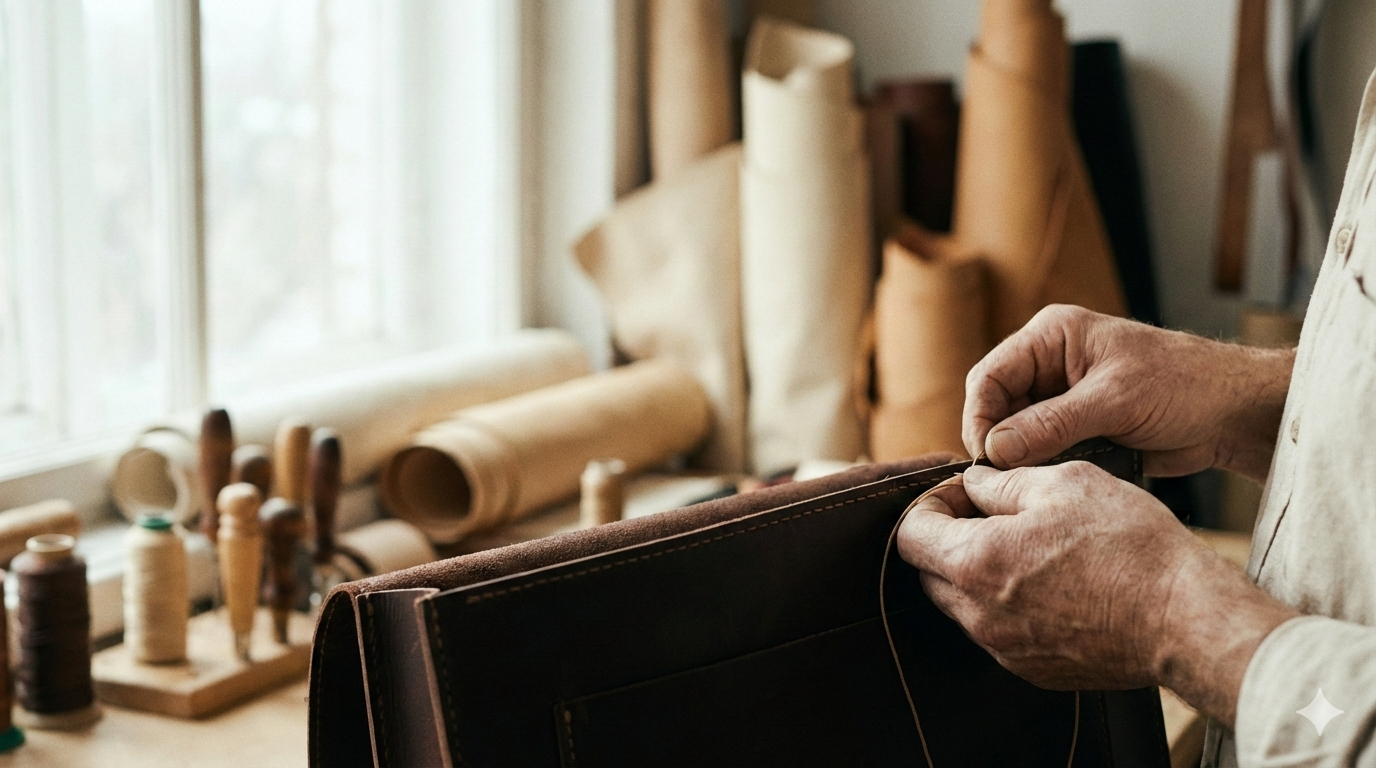
The first shift is the most visible: a deep renaissance of handcraft as the foundation of real value.
We are living through what The Interline's AI Report 2025 called the emergence of "AI-free luxury as a counter-status symbol." In a market saturated with algorithmically generated design, AI-optimised production, and instant manufacturing, the presence of genuine human time and skill has become extraordinary by definition. As creative consultant Oliver Haus put it in the same report: in a world where much of what we consume is algorithmically produced, genuine human craft signals rarity in a way nothing else can.
The evidence is accumulating across the industry's most respected names. Tod's debuted its Spring/Summer 2025 collection at Milan's PAC museum as a direct counter-narrative to the AI gold rush, spotlighting the hands of its artisans under the headline "Artisanal Intelligence." Chanel, under Matthieu Blazy's direction, partnered with Charvet, a 200-year-old tailoring house, and celebrated 50 years of collaboration with textile manufacturer Mantero, explicitly peeling back the curtain on the craft and artisans behind the designs. Advertising Week's 2026 strategy analysis identifies Hermès' sustained commitment to craftsmanship and product excellence as the primary driver behind its status as "one of the only luxury fashion houses seeing positive brand-value growth."
The numbers support the direction. A recent study cited by Luxury Activist found that 78% of luxury buyers are willing to pay a premium for items whose quality and origin are transparent. Bain's 2024 report recommends brands "realign business scale with craftsmanship heritage" through vertical integration and upstream investment. This isn't nostalgia. It's a value proposition that mass manufacturing cannot replicate by definition.
The deeper logic is what makes this shift durable. As Brede Rørstad, co-founder of creative studio No More Mondays, observed to The Interline: "Craftsmanship and true quality is slow by nature." Slowness is the signal. In an era of same-day delivery and instant gratification, a product that takes weeks to complete, made by a specific person in a specific place, using techniques passed down across generations, communicates something that cannot be manufactured at scale: that someone decided it was worth the time.
For luxury e-commerce brands, the implication is direct and commercially important. The product story is no longer supplementary marketing. Who made it, how long it took, what skill it required, and why it cannot be reproduced cheaply are now core value drivers. And how that story is told, across every digital touchpoint, from product pages to paid channels, determines whether the investment in craft actually converts.
II. The Analog Class: Deliberate Friction as Status
The second shift is subtler, and perhaps the most intellectually interesting.
As digital convenience reaches saturation, where any task, any information, any service can be summoned with minimal effort, a new class distinction is emerging around deliberate friction. The affluent are increasingly choosing to do things the hard way, and that choice has become a powerful social signal.
Consider what is quietly disappearing from mainstream life. Cursive handwriting is no longer mandated in most US state curricula; fewer than half of US states require it. The ability to read an analogue clock is declining among younger generations. The mechanical wristwatch serves no practical function that a smartphone cannot perform better. And yet each of these things is experiencing a resurgence among those who can afford to cultivate them.
This is not a coincidence or nostalgia. It is a coherent logic. When something becomes rare, its possession becomes meaningful. And when an entire class of skill requires patient practice, the kind of practice that busyness and algorithmic convenience have stripped from most people's lives, that skill itself becomes a form of social capital.
Research compiled by National Geographic and studies conducted in Norway, Japan, and the United States consistently show that manual writing produces stronger memory encoding and greater neural activation than keyboard input. Professor Naomi Baron of American University notes that "people are better at remembering things they have written manually than on a computer." The wealthy are not just choosing the aesthetic of cursive. They are choosing a cognitively superior technology that is also increasingly rare.
The mechanical watch follows the same logic. nss magazine recently described "analogue rooms", screen-free spaces deliberately designed into high-end homes, as "the real luxury of 2026." These are not rooms without screens because the owners cannot afford them. They are rooms without screens because the owners can afford to refuse them. The distinction is everything.
The broader pattern is what we might call the deliberate friction class: people who choose to do things slowly, manually, and with embodied skill in a world that defaults to speed, automation, and minimum effort. Writing letters by hand. Cooking from raw ingredients. Reading physical books. Playing instruments. Growing things from seed. None of these are expensive. All of them are time-intensive. Time, not money, is what makes them luxurious, and time is precisely what the truly affluent are hoarding.
III. The Invisible Luxury: Privacy, Autonomy, and the Right to Disappear
The third shift is the hardest to commodify, and for that reason, the most valuable.
Fortune reported that the ultra-rich are abandoning conventional luxury symbols in favour of more abstract values: privacy, leisure autonomy, and the ability to be unreachable. Brand strategy consultant Eugene Healey articulated the trend precisely: "Being chronically offline is the new flex." In a world where most people are trapped in a chronic feedback loop of notifications, algorithms, and performance metrics, measuring their lives in views, response times, and engagement rates, the ability to simply not be there has become an extraordinary privilege.
The World Economic Forum asked its audience whether we would see a gap between the "privacy rich" and the "privacy poor." Seventy-nine per cent said yes. A subsequent poll on Time.com found the figure at 91%. That prediction has now materialised. The wealthy employ what PwC's Wealth Report identifies as "digital privacy managers", a job title that did not exist a decade ago. Elite travellers seek private villas in the Maldives and Seychelles where staff disappear when not needed, and retreats where the absence of a mobile signal is listed as an amenity. The silence of such places is not a drawback. It is precisely what is being sold.
But privacy in this context is more than data protection or physical seclusion. It is a philosophy of presence, the ability to exist without being tracked, measured, or obligated to perform. Silvia Bellezza of Columbia Business School has documented through research how leisure time, and specifically how one chooses to spend it, has become a primary class signal. The ultra-wealthy are not showcasing possessions. They are showcasing how they exist: time for genuine personal development, for skills, for presence, for deliberate idleness.
The concept of being outside of systems, outside of the HR software, the surveillance architecture, the always-on availability that defines most professional lives, extends naturally into work. The freedom to design your own schedule, to not be managed by software, to be genuinely unavailable, to work from wherever you choose: these are not features of a job. At the highest levels, they are the definition of wealth.
For brands, the implications are sharp. The customer who values privacy does not want to be followed across the internet by retargeting advertisements. The customer who values autonomy does not want friction-heavy loyalty programmes that feel like obligations. As IMD's 2026 luxury analysis found, "purely digital or contactless solutions are losing relevance in the luxury segment, guests appreciate technology, but not at the expense of human connection." The experience architecture of a luxury brand must now reflect the values its customers are actually buying. And those values centre on space, discretion, and the sense that one is dealing with people, not processes.
This matters enormously for digital advertising strategy. Reaching privacy-conscious, affluent consumers requires precision over volume, the right message, in the right context, to the right person, without the blunt-instrument approach that alienates the very customer you're trying to attract. Spray-and-pray is not a luxury strategy.
IV. The Body as Status: Wellness and Longevity as the New Trophy Asset
The fourth shift is the most recent, and according to VML's Future 100: 2026 report, perhaps the most significant: "Health is the new ultimate wealth. Status is shifting from what you wear to who you are, with biometric data, longevity metrics, and competitive wellness replacing material possessions as the new badge of honour."
What you own has always been visible. What you can do, how you age, and how you perform physically and cognitively are becoming the new frontier of status display. This is the logical endpoint of the previous three shifts. If the artisan economy is about choosing objects made with time and care, if the analog class is about choosing activities that reward embodied skill, and if the privacy premium is about reclaiming life from systems, then the body itself is the ultimate expression of all three.
Longevity medicine, once a niche pursuit of Silicon Valley billionaires, has entered mainstream affluent culture. Private health diagnostics, personalised nutrition protocols, VO2 max scores, biological age testing, elite sleep coaching, and competitive wellness pursuits like endurance running and cold-water swimming are now genuine status markers among the wealthy, markers that cannot be purchased as easily as a handbag and cannot be faked with a dupe. Deloitte's 2026 Global Powers of Luxury found that luxury travel now has the highest growth potential of any segment, with 36.2% of executives identifying it as the leading opportunity, and the fastest-growing subset of that is wellness-driven travel: retreats, longevity clinics, biohacking resorts.
IMD's analysis of 2026 luxury trends notes that "wellness, longevity, experiences, and distinctive craftsmanship are no longer peripheral but central to how affluent clients allocate spending." For many younger wealthy consumers, the pursuit of physical excellence has become a new form of identity expression, one that is visible, discipline-dependent, and non-transferable.
The implication for luxury brands extends beyond the obvious wellness product category. Any brand whose products connect to how the body feels, performs, moves, or ages, fine horology that rewards mindful attention, food and drink that connects to ritual and nourishment, activewear and equipment that enables physical ambition, even fragrance and skincare understood through a wellness lens, is operating in an increasingly powerful space. The question is whether the brand story is being told in those terms.
V. The Unifying Thread: Time Is the New Currency
Beneath all four of these shifts lies a single, deeper truth.
Time has always been the one resource that wealth cannot simply manufacture. But in the age of hyper-connectivity, AI automation, and the always-on economy, genuine, uninterrupted, self-directed time has become acutely scarce in ways it never was before. The artisan economy is about time baked into objects. The analogue class is about choosing activities that reward time spent. The privacy premium is about reclaiming time from systems that extract it. The wellness turn is about investing time in the body as the ultimate long-term asset. They are the same argument from four different angles.
Euromonitor's 2026 data confirms the market is already voting accordingly: personal luxury goods remain under pressure, while experiential luxury, travel, wellness, and hospitality continue to grow. The market is moving from things that display wealth to ways of living that embody it.
VML's Future 100 report describes the emerging luxury consumer as one seeking "health, wealth, and stealth." The stealth matters. The new luxury does not announce itself. It does not need to. That restraint — the confidence not to perform, not to display, not to explain — is perhaps the most powerful signal of all.
What This Means for Luxury Brands in 2026
The implications are specific and commercially urgent.
Luxury Tribune's 2026 forecast found that 70% of consumers are currently unsatisfied with their in-store experience, and 90% feel the customer experience is essentially identical across luxury brands. This is both a damning verdict on the industry over the past decade and an extraordinary opportunity for brands willing to differentiate on what actually matters: genuine craft, considered experience, and human connection.
The product story must become the product itself. In a market where manufacturing origin, artisan biography, materials provenance, and hours invested are themselves value drivers, brands that cannot tell this story — or whose supply chains cannot support it — are structurally disadvantaged. Investment in traceability, in artisan relationships, and in the communication of genuine process is not a marketing expense. It is a core product investment that needs to be reflected across every channel, including digital.
The experience must match the values. A privacy-conscious, autonomy-driven customer who values human craft will be alienated — not converted — by aggressive retargeting, loyalty programmes that feel like surveillance, or a digital experience that treats them as a data point rather than a person. The digital experience of a luxury brand must feel as considered as its product. This is not a small ask. It requires an advertising and content strategy that is genuinely different from what works for mass-market brands.
The audience definition has changed. The customer who once bought status objects to display wealth is still there. But the customer shaping the market's direction has largely solved the question of what to own and is now asking deeper questions about how to live. Marketing that speaks to identity, craft, embodied skill, and lived experience — rather than aspiration and display — will resonate. Marketing that speaks to neither will produce the 35% brand-value decline, nor the 17% growth.
The Opportunity
The brands that understand this shift early have a disproportionate advantage. The global luxury goods market is projected to reach nearly $440 billion by 2026, growing toward €460-500 billion by 2030, per Bain's forecast. Within that market, the brands that genuinely inhabit the "new luxury" positioning — craft, analog values, privacy, wellness — attract consumers who are less price-sensitive, more loyal, and immune to dupes and competitor discounts. They are not comparing. They are committing.
The future of luxury is not louder, shinier, or more digital. It is quieter, slower, more human, and more deliberate. The market data, the executive surveys, and the consumer research all point in the same direction. The brands that move first — and build the digital and brand infrastructure to reach and convert this new customer — will not just survive the decade. They will define it.
This article was written by No7. Digital, a performance marketing agency specialising in luxury and premium e-commerce. We help ambitious brands build digital strategies that earn the attention of discerning customers, precisely targeted, beautifully positioned, and built around what the modern luxury consumer actually values.