
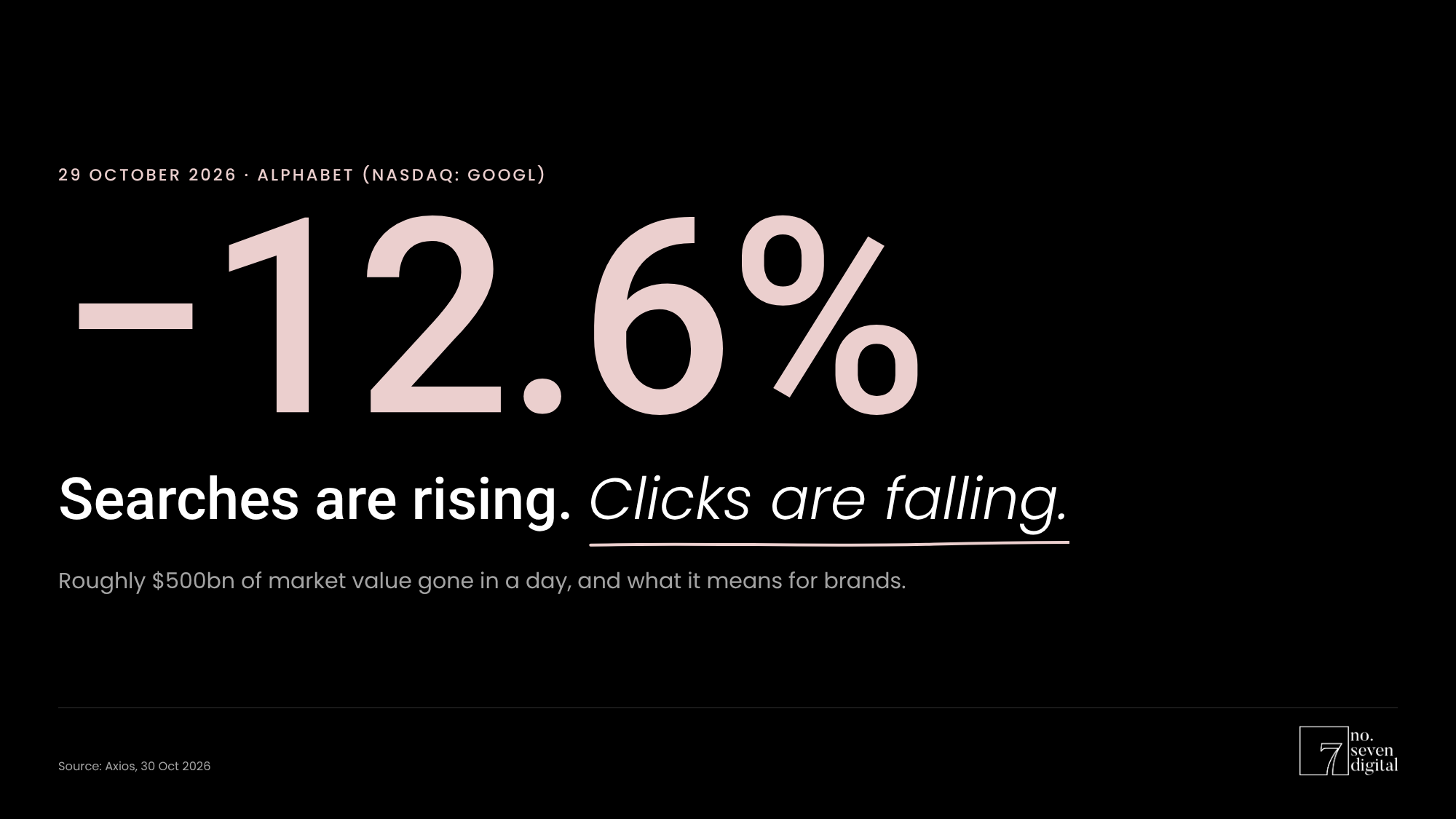
Alphabet just had the worst day in its stock market history. The reason matters more for brands than the headline does, especially in luxury.
Key takeaways
Alphabet shares fell 12.6% on 29 October 2026, wiping out roughly $500bn in market value. It was the stock’s worst day on record.
Google Search revenue still grew 12%, and query growth is at a five-year high. The sell-off was mainly about the cost of AI and slower search monetisation.
The real shift for brands: searches are rising, but fewer of them end in a click to a website.
Luxury shoppers are early adopters. 82% of top-tier luxury buyers used AI in their most recent purchase.
Not every business needs to invest in GEO today. Every brand should know what AI says about it.
What happened to Google’s share price?
On Thursday 29 October 2026, Alphabet shares closed down 12.6%, erasing more than half a trillion dollars of value in a single session. Bloomberg called it the company’s biggest-ever market plunge, and it was the second-largest one-day loss of market value for any US stock.
The headlines settled on a simple story: AI is eating Google. It’s a good line. It isn’t quite what the numbers say.
Alphabet’s third-quarter earnings release shows revenue up 25% to $127.6bn and Google Search revenue up 12% to $63.4bn. Google also said year-on-year search query growth was the highest it has been in five years. People are not abandoning Google.
So what spooked investors? According to XTB’s breakdown of the results, capital expenditure more than doubled to $51.4bn as Google builds AI infrastructure, pushing free cash flow negative. Earnings per share came in at $2.12 against expectations of around $3.00, dragged down partly by an $8.7bn investment loss. And search ad sales, while still growing, missed forecasts and grew at their slowest pace in five quarters.
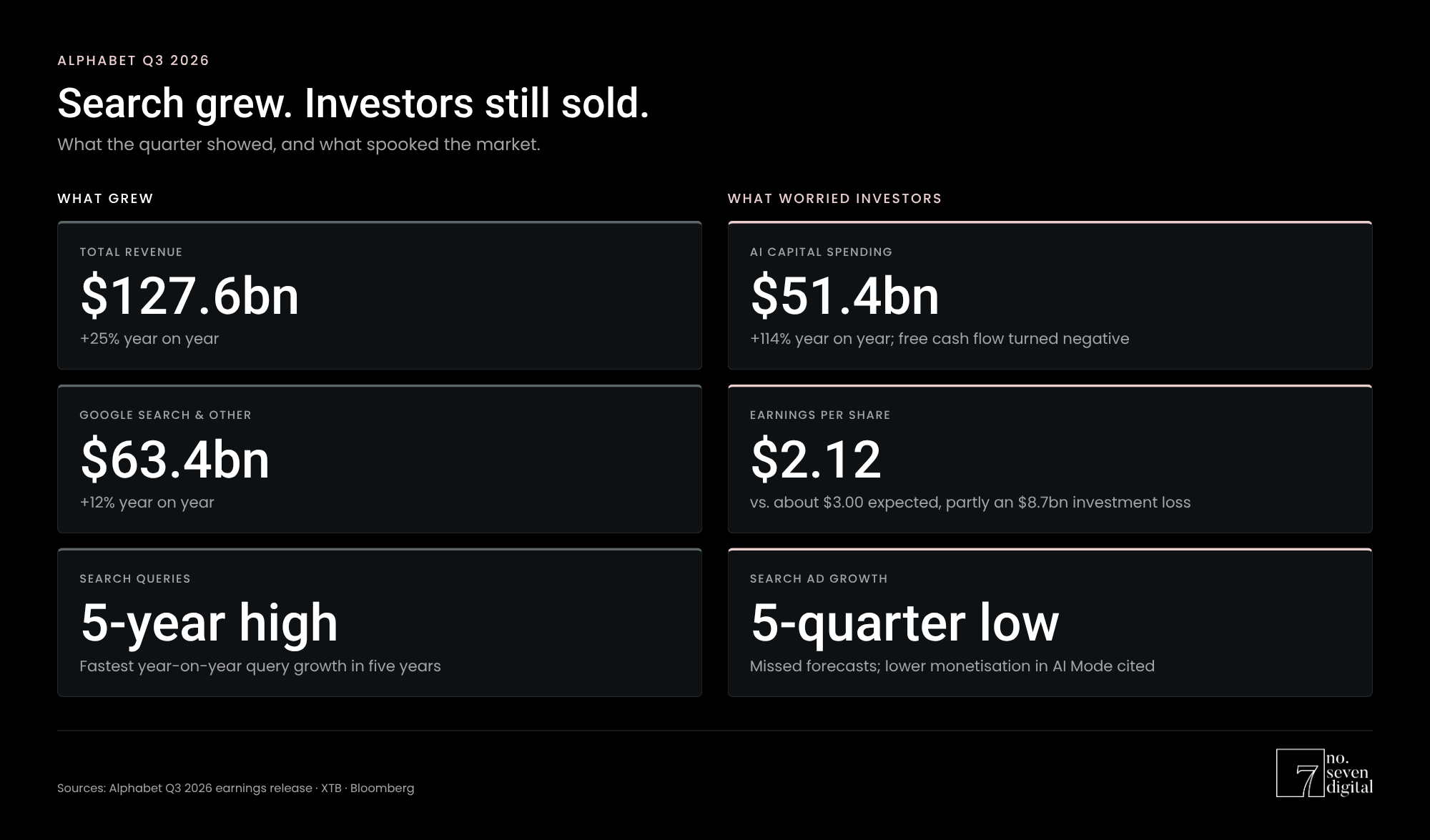
Search grew. Investors still sold.
One more detail is the one that matters for brands. On the earnings call, chief business officer Philipp Schindler said Google is scaling ads in AI Overviews and AI Mode, and lower monetisation in AI Mode weighed on search growth during the quarter.
Is AI eating Google search?
Not in the way the headlines suggest. Demand for search is growing. What’s changing is how search pays.
Google is building one experience that combines AI Overviews, AI Mode and traditional search, with much longer, conversational queries. When Google answers the question itself, there are fewer places for ads and fewer reasons for anyone to click away.
“People aren’t searching less. They’re clicking less.”
That is what investors priced in on 29 October. It’s also what every brand that depends on Google should be paying attention to.
If searches are rising, why are clicks falling?
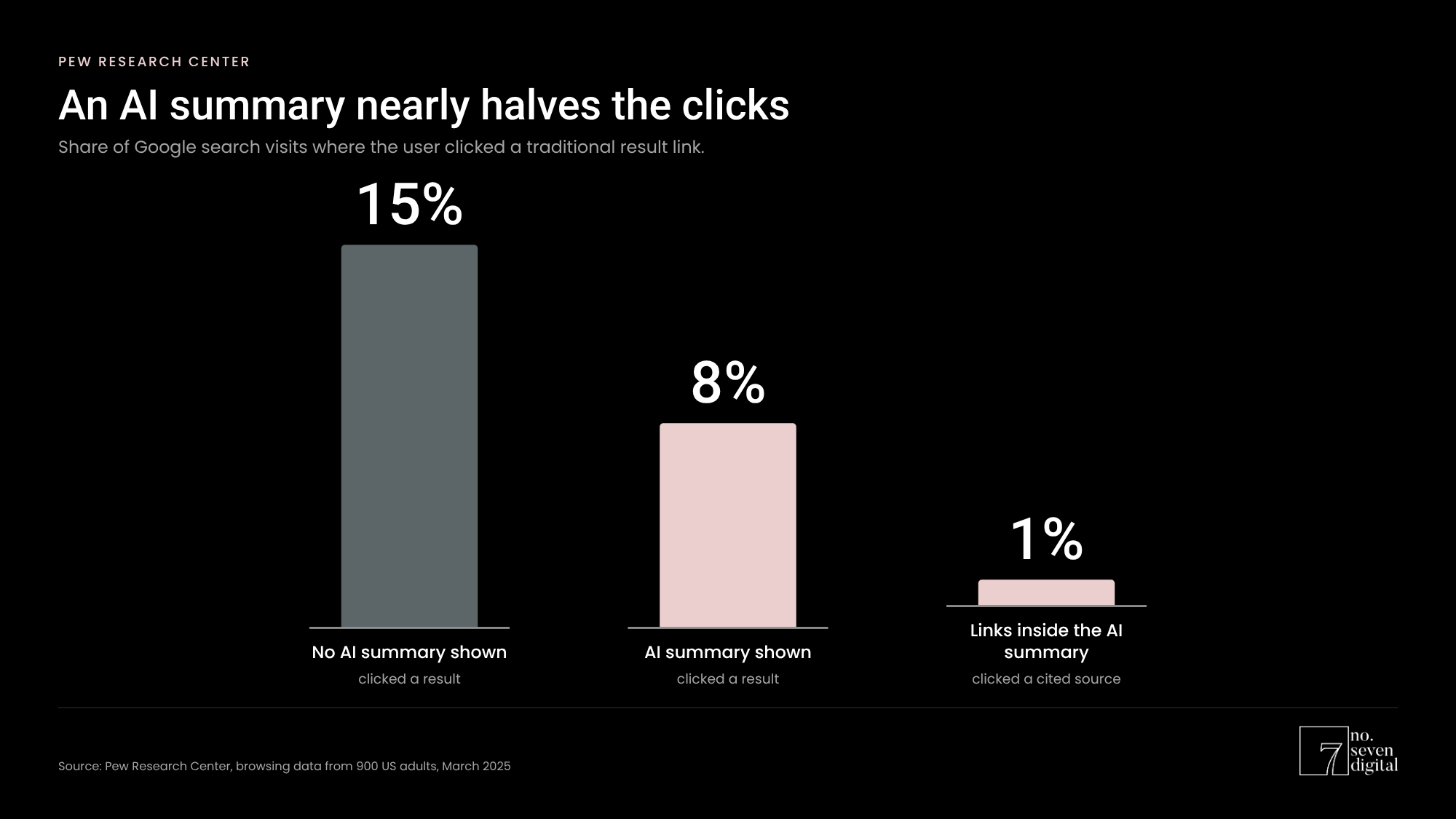
Because more answers now arrive on the results page. The Pew Research Center tracked the browsing of 900 US adults and found that people clicked a traditional search result in 8% of visits when an AI summary appeared, compared with 15% when it didn’t. Links inside the AI summary were clicked in just 1% of visits.
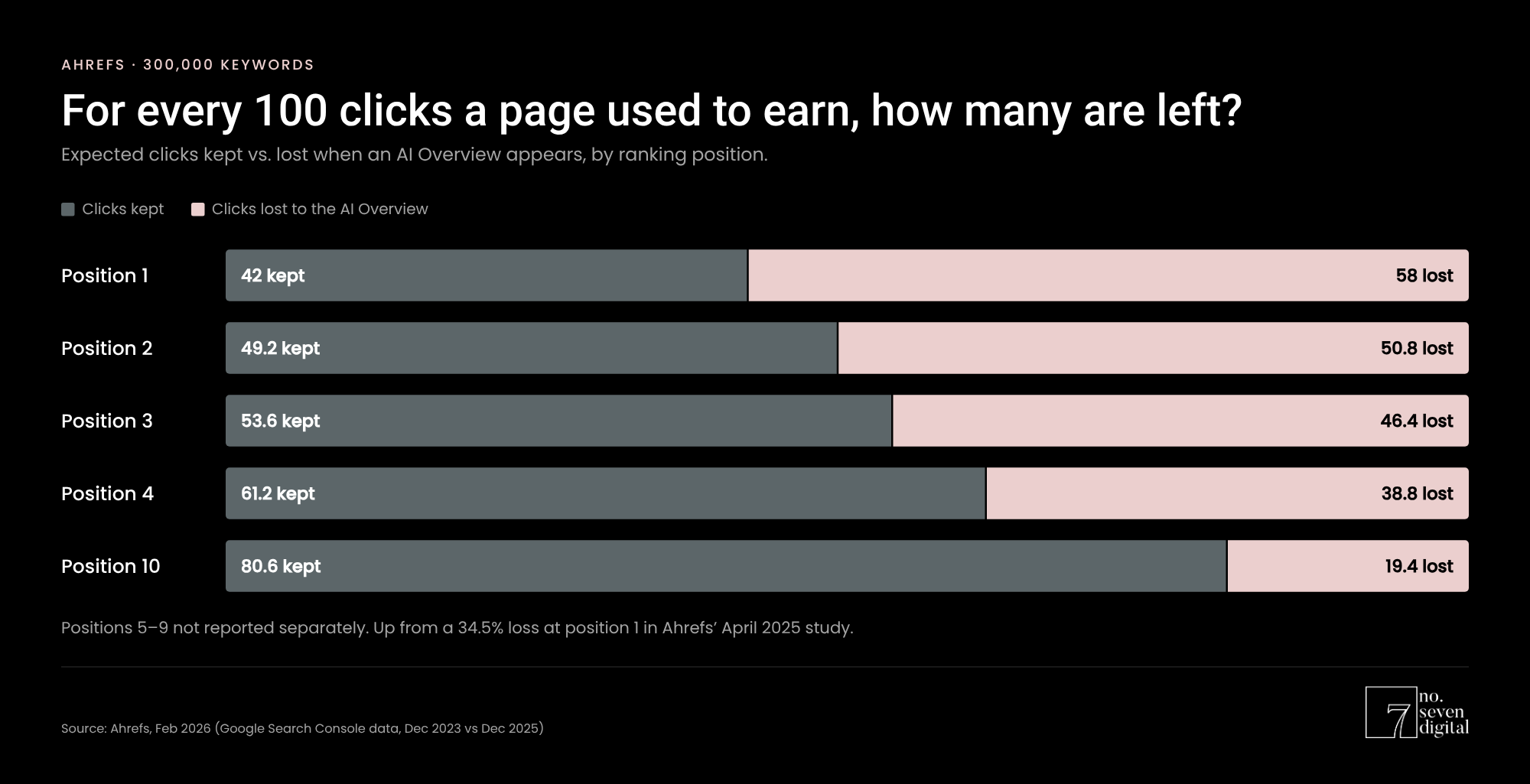
Ahrefs found the same pattern at scale. Across 300,000 keywords, an AI Overview correlated with a 58% lower click-through rate for the top-ranking page, up from 34.5% in its study less than a year earlier. Even the page in position two lost about half its expected clicks.
The picture isn’t uniform, and it’s worth being balanced. Market-wide, Graphite data covered by Search Engine Land put US organic search traffic down just 2.5% year on year. Seer Interactive saw click-through rates on AI Overview queries recover in early 2026 after a steep 2025 decline. And commercial and branded searches have held up better than informational ones.
The honest reading: if your website wins visitors by answering questions, you’re exposed now. If people find you by searching your name, you have more time. The direction of travel is clear either way.
What does AI search mean for luxury brands?
Luxury is where this is moving fastest, because the most valuable customers are the earliest adopters. Bain & Company and the Comité Colbert’s 2026 Luxury and Technology report found that 82% of top-tier luxury shoppers used AI in their most recent purchase, compared with 28% of low spenders.
How they use it is revealing. In the Bain report, 64% of luxury shoppers who use AI used it to research a product or brand, 43% to summarise reviews and 42% to compare prices. Around 97% plan to use it again. BCG’s True-Luxury consumer study points the same way: 87% of respondents use generative AI weekly, and around 80% of those already use it to research luxury.
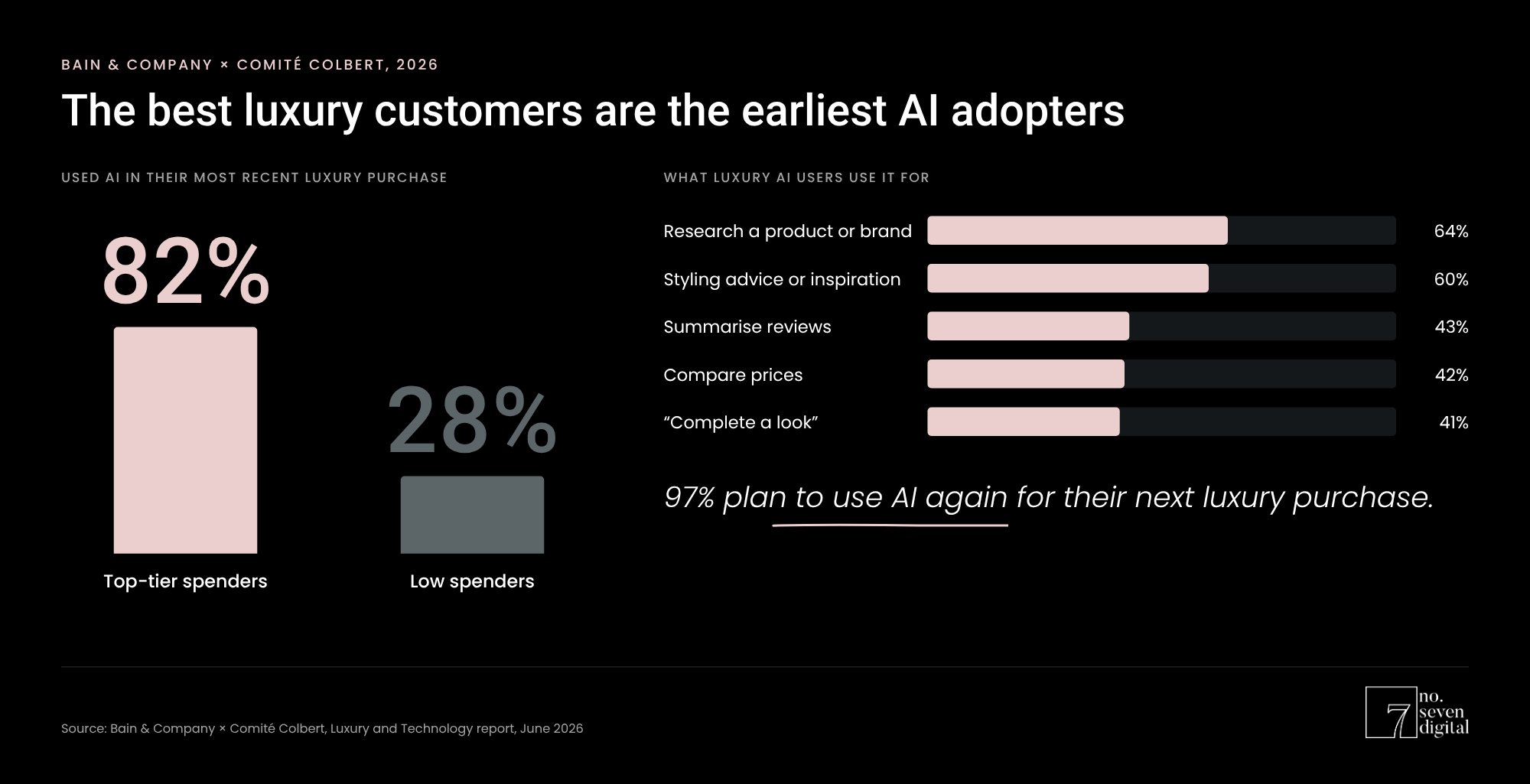
Two findings should make any founder pause. First, shoppers using AI often begin with broad questions rather than brand names. They ask for the best handmade gold earrings, not for you. If you aren’t part of the category answer, you aren’t on the shortlist. Second, 90% of the URLs AI search engines cite for luxury queries point to sites other than the brands themselves
“AI is already telling your brand’s story. Mostly in other people’s words.”
For a founder-led brand, that cuts both ways. Press coverage, gift guides, stockist pages and reviews carry more weight than ever, which rewards brands that have earned them. But the details you care most about, from provenance to craft to how a piece is made, may be summarised by sources you don’t control.
Does the brand website still matter?
Yes, arguably more than before. AI shapes the shortlist, but your site still has to win the final check.
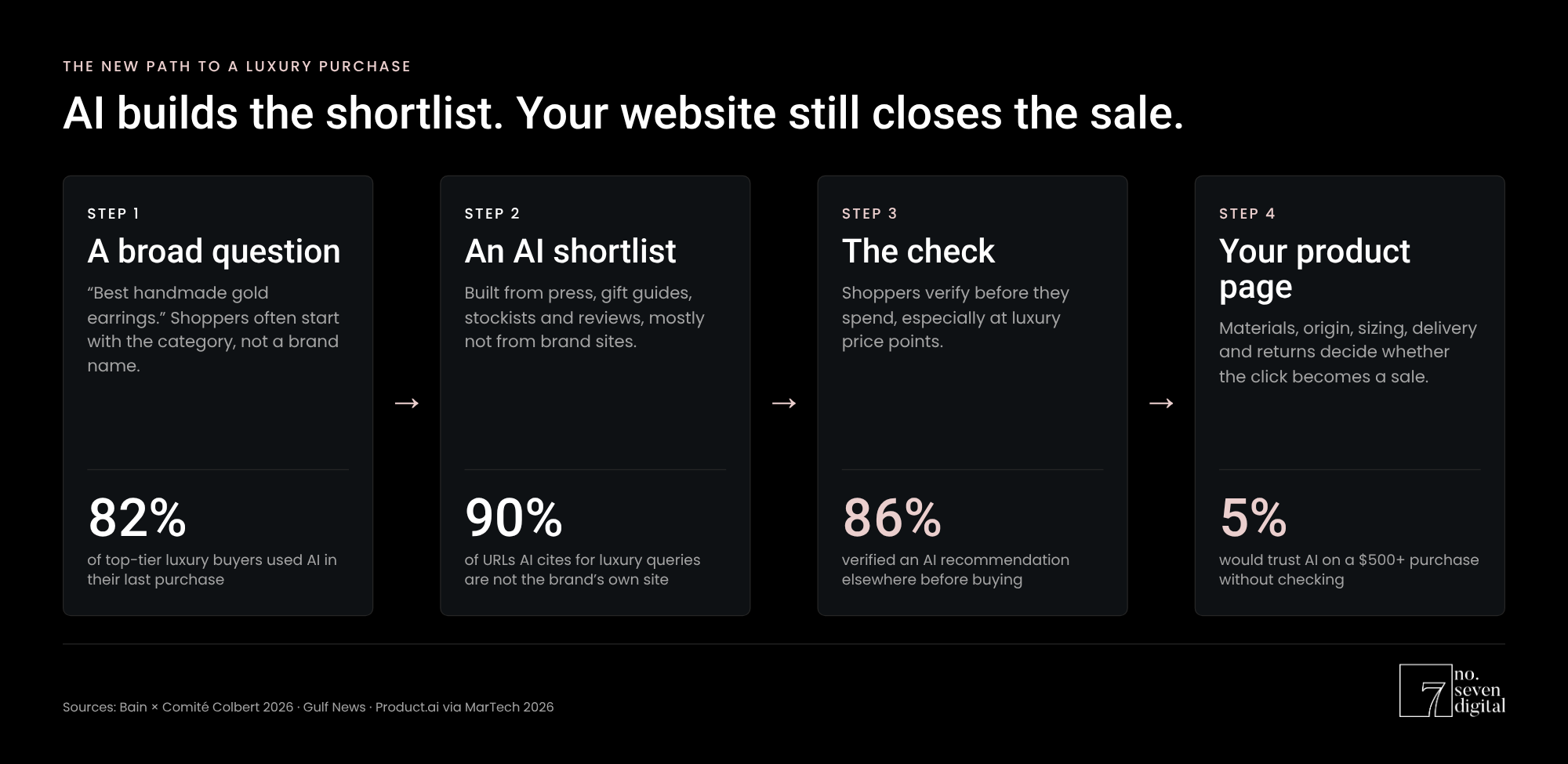
A 2026 Product.ai survey reported by MarTech found that 86% of US shoppers who used AI for product research verified the recommendation through another source before buying. Only 5% would trust AI on a purchase over $500 without checking elsewhere.
At luxury price points, that second check is often your product page. If it’s thin on materials, sizing, delivery or returns, you can lose the click you did earn. Our Luxury Conversion Funnel Leak Detector is a quick way to see where that’s happening.
Does every business need to invest in GEO right now?
No. Generative Engine Optimisation, or GEO, is the work of making sure AI tools understand, cite and recommend your brand accurately. It matters, but it isn’t the first priority for everyone. Here’s how we’d decide:
| When | Signs this is you | What to do |
|---|---|---|
| Act now | New customers find you through guides or informational content. Your category is research-heavy and high-value (fine jewellery, furniture, tailoring). Press and stockists describe you better than your own site does. | Check what AI says about you, fill the gaps on your own site, and invest in the third-party sources AI cites. |
| Prepare over 6–12 months | Strong brand demand. Most of your search traffic comes from people already looking for your name. | Protect branded search, track AI mentions quarterly and strengthen product and category pages. |
| Watch for now | Most sales come from repeat customers, word of mouth or wholesale. Very little comes from search. | Keep the fundamentals in order and revisit in six months. |
The worst response is panic spending. The second worst is ignoring it. If Google’s own revenue can shift in a quarter, a brand’s traffic can too.
Three checks a founder can do this week
Ask AI what a buyer would ask. Put three questions a new customer might ask into ChatGPT, Gemini and Google’s AI Mode, such as “best handmade gold jewellery in London” or “luxury cashmere knitwear made in Scotland”. Note whether you’re named, who is, and which sources are cited.
Compare impressions and clicks. In Google Search Console, look at non-brand queries over the last 12 months. If impressions are steady or rising while clicks fall, you’re losing the click, not the demand.
Read your product pages as a sceptic. Would someone arriving from an AI answer find the materials, origin, sizing, care, delivery and returns information they need to buy with confidence? If not, that’s the first fix.
The bottom line
Google’s worst day on the stock market wasn’t proof that search is dying. It was the market pricing in how search is changing: more questions, more answers on the page and fewer clicks to websites. For luxury brands the stakes are higher, because your best customers are already using AI to decide.
You don’t need to rebuild your marketing around it. You do need to know where you stand. That’s what our Diagnostic is for: a look across SEO, paid search and conversion before recommending anything. If you’d like a view on how AI sees your brand, get in touch.
Frequently asked questions
Why did Alphabet’s stock fall in October 2026?
Alphabet shares fell 12.6% on 29 October 2026 after its third-quarter results. Revenue grew, but heavy AI spending pushed free cash flow negative, earnings per share missed expectations and search ad sales grew more slowly than forecast. Lower monetisation in Google’s AI Mode was cited as a factor.
Is Google search declining?
No. Google Search revenue grew 12% to $63.4bn in Q3 2026 and Google reported its fastest query growth in five years. What is declining is the share of searches that end in a click through to a website.
What is GEO?
Generative Engine Optimisation (GEO) is the work of improving how AI tools such as ChatGPT, Gemini and Google’s AI Overviews understand, describe and recommend a brand. It builds on SEO but focuses on being cited accurately in AI-generated answers.
How are luxury shoppers using AI?
Bain & Company and the Comité Colbert found that 82% of top-tier luxury shoppers used AI in their most recent purchase. Most use it to research brands, compare options and summarise reviews, then check details elsewhere, often on the brand’s own site, before buying.
Should my brand invest in GEO now?
It depends on how customers find you. Brands that rely on informational content, or sell research-heavy, high-value products, should act now. Brands with strong branded demand can prepare over the next six to twelve months.